How to organize a successful business meeting? What is worth considering

Business meetings transferred from the office to the restaurant ceased to be just an exchange of information - they became an opportunity to build real acquaintances. Your counterparty is no longer “on the other side of the negotiating table”, but is the man sitting opposite, with whom you share a meal and discover common interests.Psychology confirms what we intuitively know: a pleasant environment lowers defensive barriers and facilitates agreement. Eating together is one of the most powerful confidence-building mechanisms — it's been around for thousands of years of human evolution.We've put together a guide to help you organize a business meeting—from the first booking to the last handshake. No generalities, just proven practices that work in the real business world.
Why organize business meetings in a restaurant?
Neutral ground promotes openness
Inviting a client to your own office often creates an uneven situation. A small rented room, old equipment - all this can affect the reception of your business. On the other hand, when a customer invites you to their office, you may feel uncomfortable.The restaurant changes this dynamic completely. No one has territorial advantage. There is no “host” and “guest” in the traditional sense—there are only two parties on equal terms. This is a psychologically huge difference that facilitates open communication.
Building relationships through a meal together
Anthropologists have been repeating the same thing for years: eating together is the most primitive way to build social bonds. Something that has worked for thousands of years also works in modern business.At a business dinner, you learn things that you will never hear in a conference room. Your contractor rides a mountain bike, he just got back from Iceland, he has three children. Does this information seem irrelevant? On the contrary — it is the foundation of long-term cooperation.At the next meeting you can ask “how to go to the Tatras?” , or relate to common interests. Suddenly you are no longer just numbers on a spreadsheet — you are people who understand each other. Many companies use the rule: the first contact is always at lunch, because it is impossible to build a long-term cooperation with someone you do not know.
Positive associations influence decisions
The human brain works on shortcuts. When you sit in a beautiful restaurant, eat a perfectly prepared tuna and drink it with a wine that surprises with its taste, your limbic system writes: “this is good.” And this “good” subconsciously transfers to the whole situation, including the business proposal that you are just listening to.We are not talking here about manipulation, but about simple psychology. That's why companies spend a lot of money on event marketing. That's why Apple opens stores that look like works of art. therefore company meeting in a good restaurant is an investment, not a cost.Remember: if you invite someone to any place, then this person will understand it this way: “I don't care enough about you.” If you choose a restaurant from a real event, you will give a signal: “this conversation is important to me.”
How to choose the perfect restaurant for a business meeting?
Location and availability
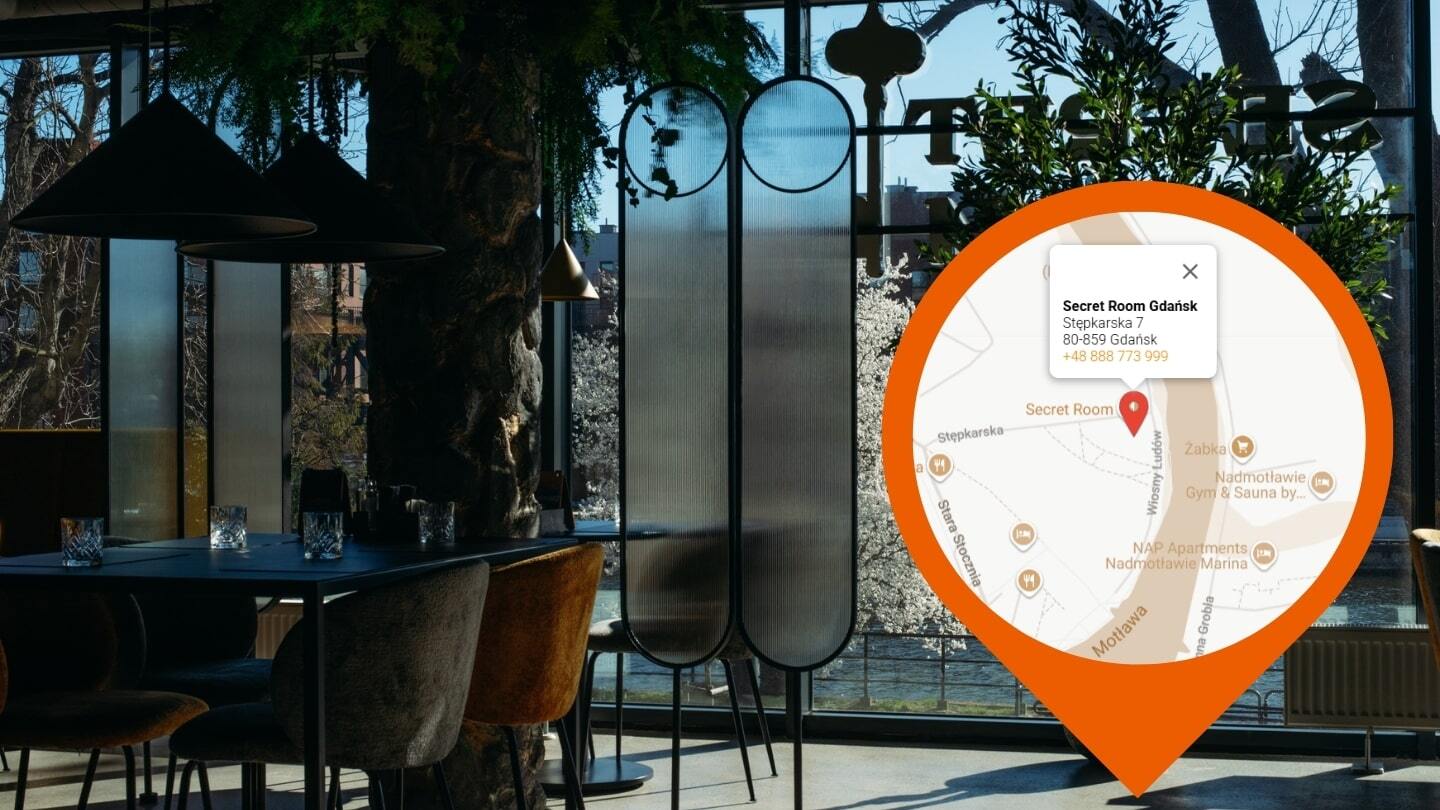
The test is simple: enter the address of the restaurant in Google Maps and see how much your contractor will drive. If you see “1 hour 15 minutes in traffic” — search further. No one will appreciate your brilliant business proposal if before the meeting he stood for half an hour in a traffic jam on the ring road.The second question is parking. In city centers, this is sometimes a problem. Restaurants that have their own parking or contracts with nearby garages save guests nerves. And nerves translate into mood, and mood into the quality of the conversation - everything is connected.Secret Room In Gdansk, it solves both issues. The central location means a maximum of 15-20 minutes drive from most points of the Tri-City. Add to that parking nearby and access to major transportation arteries — you have a place that is not a logistical challenge.Public transport? Check it out too. Not everyone comes by car, and standing at a stop in the rain for 20 minutes before an important meeting does not add charm.
Atmosphere and acoustics
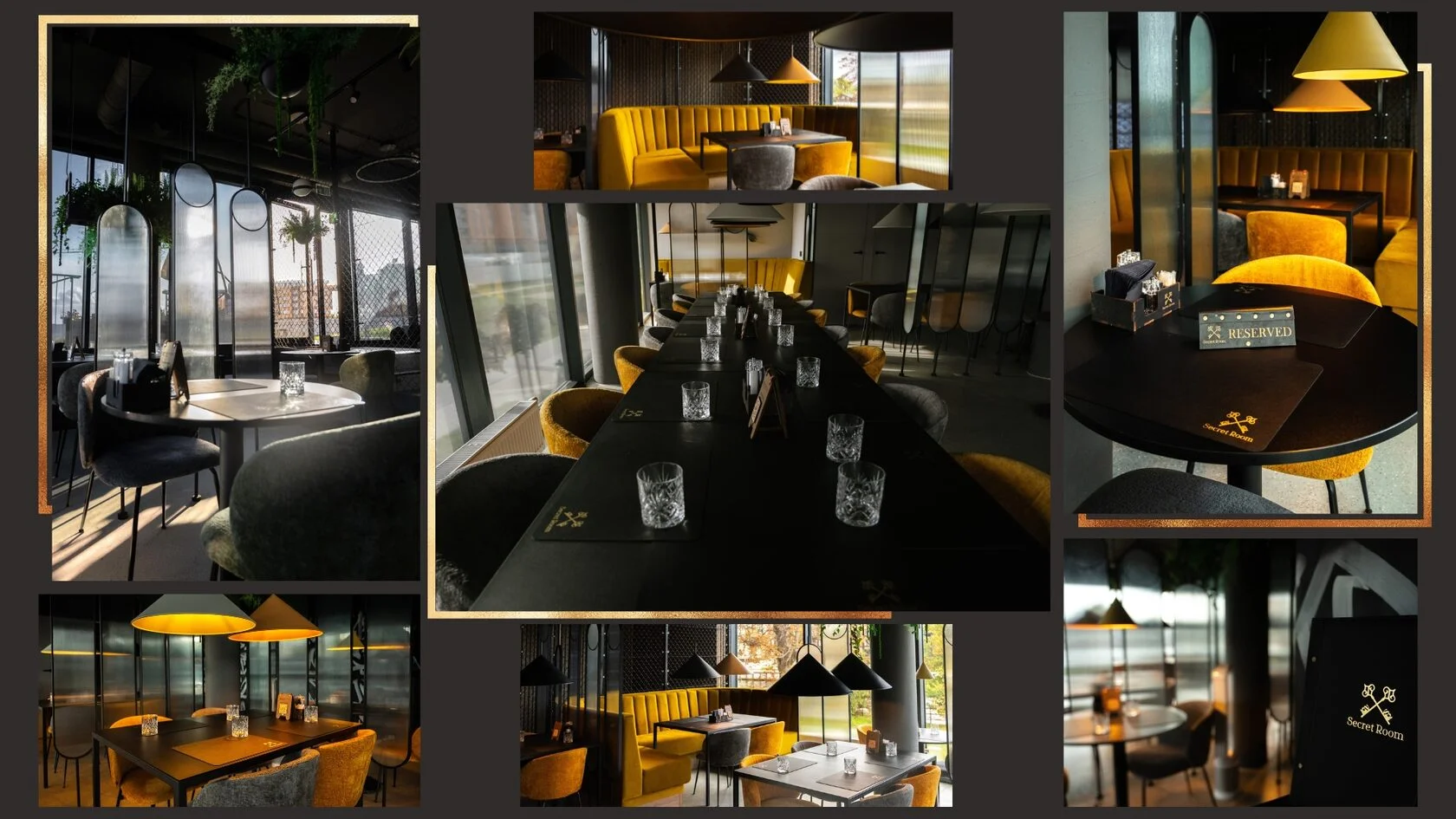
A restaurant with an open kitchen, loud screens with sports and tables set too densely is the worst choice for a business meeting. In such a place you hear all the conversations around, and after 20 minutes your head hurts. Talking about the contract becomes impossible.Check before the visit:
- Distance between tablesi — minimum meter, preferably more
- Music Level — is intended to be audible, but not dominant (check Google reviews)
- Illumination — natural or warm, certainly not cold LEDs like in a hospital
- Overall volume — if the words “lively” or “party atmosphere” appear in the descriptions, run away
Menu and quality of cuisine
Trendy restaurants with “innovative molecular cuisine” can make a bad impression at business meetings. Miniature portions that look like art installations can leave guests hungry and annoyed. This is not the best scenario for the development of cooperation.Menu for business meetings should be:
- Understandable — when you read the name of the dish, you know what you will get
- Diverse — meat, fish, vegetable options
- Qualitative — fresh ingredients, not frozen food from Makro
- Universal — everyone will find something for themselves
European cuisine is the foundation — proven, recognizable, safe. But it's good when there are also alternatives. The Secret Room combines European classics with WOK cuisine and street food — a flexibility that works for every level of meeting formality.One detail: if the restaurant website does not have an up-to-date menu with prices — red flag. Professional sites are not afraid to show what and for how much they offer.

Service and professionalism
A waiter who comes up every 5 minutes to ask “is everything okay?” — annoying. A waiter who is never there when you need a refill of water — just as annoying. The golden mean is a discreet presence: it sees what you need before you notice it yourself.Professional service in a business restaurant:
- Recognizes business meetings and gives space
- Serves all dishes at once (no one waits)
- Remembers preferences (coffee without sugar, carbonated water)
- Does not interfere with conversations with a curiosity about the menu
How to check it before the first visit? Read the reviews carefully. People write about the service honestly - if there is a problem, you will see it in the first ten reviews.Online booking It is also a test of professionalism. An efficient website, an email confirmation and the ability to mark details are signals that the restaurant knows what it is doing.
Additional amenities
In 2025, business meetings may often require technical support. Laptop, presentation, quick show of data from the phone is the standard, not the exception.Check out:
- Wi-Fi — check if it is and if it works (ask for a password when booking and test)
- Sockets Best at every table
- privacy — whether it is possible to reserve a separate noon/hall for a larger group
- Accessibility — driveway for strollers, toilet available
Some restaurants have dedicated meeting spaces. This is an exaggeration for a meeting of 2-3 people, but with larger groups (5+) it can be a good option.
Types of business meetings in a restaurant — which one to choose?
The time of day matters — each type of meeting has its own dynamics and purpose.
Business breakfast (7:00-10:00)
Time: 45-75 minutes. Everyone is rested and focused. Ideal for: networking, first meetings with the client, quick project arrangements. People have a full day ahead of them, so they focus on specifics. No room for empty talk.
Business lunch (12:00-14:00)
Time: 90-120 minutes (maximum 2 hours). The most popular form of business meeting. It has a formal character — like an office meeting, but without the rigidity of a conference room. It is suitable for: contract negotiations, presentation of offers, discussion of project details. Structure: 15 min warm-up, 60 min main course, 15-30 min summary with coffee.
{{ctablock}}
Preparing for a business meeting — step by step
Business dinner (18:00-21:00)
Time: 2-3 hours. The most elegant and least formal option. This is where you get to know each other as people, not just your business roles. Ideal for: celebrating the signing of a contract, building long-term relationships, integrating teams. At dinner, alcohol is acceptable (a glass of wine, two drinks maximum), conversations can deviate from strict business - this builds trust.
Determining the purpose of the meeting
“Can we meet and talk?” — this is not a plan.Before you send an invitation, answer yourself the questions:
- What specifically do I want to achieve?
- What information do I need to get?
- What decisions are there to collapse?
Example: Meeting with a software provider. Main objective: to determine if their system integrates with our CRM. Side objectives: to know the length of the implementation, the costs of support. Decision: do we go to the tests? Write down the main points before the meeting. It's five minutes that change everything.
Booking and logistics
Rule 3-5-7:
- 3 days — minimum for a standard restaurant
- 5 days — popular business locations
- 7 days — weekends and holidays
Online booking works 24/7. Confirm the day before by SMS or phone.What to include:
- Number of persons (with margin)
- Specific time
- Quiet corner, away from the kitchen/entrance
- Special needs (power outlet, wheelchair access)
Agenda and time management
Anatomy of a business lunch (90 minutes):
- 0-15 min: Greeting, small talk, order
- 15-75 min: Main course content
- 75-90 min: Summary over coffee
A business meeting should not last more than 2 hours. After this time, the concentration decreases.
Preparation of participants
Invitation email (minimum 3 days in advance):
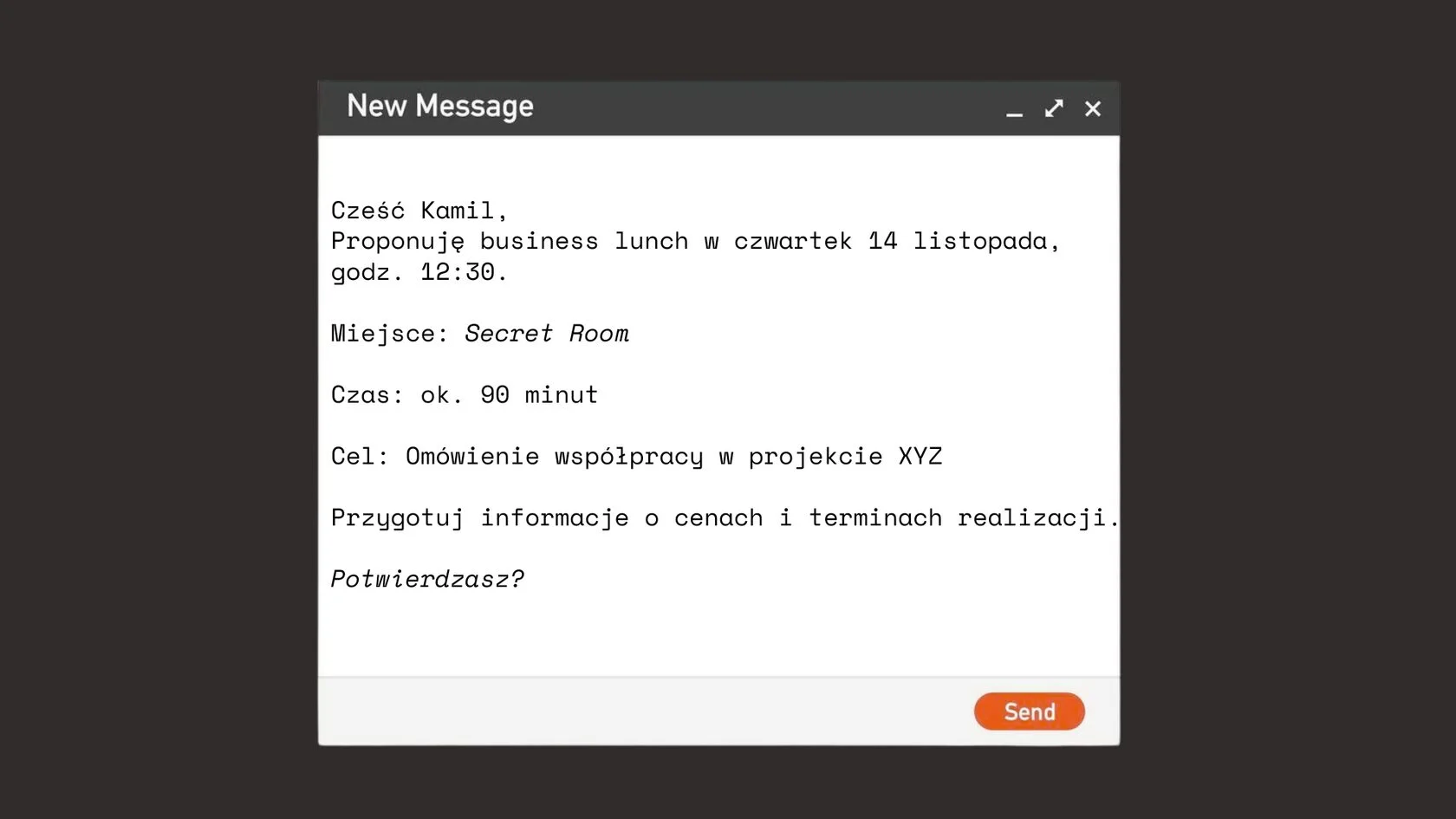
It contains everything: where, when, for how long, for what. Everyone knows what this is about.
Etiquette during a business meeting — How to behave?
Punctuality is the basis
Being late for a business meeting says one thing: “my time is more important than yours.” It doesn't matter if it's true or not — that's how the other side perceives it.Come 5-10 minutes early. Not 30 minutes (it's embarrassing for the restaurant and strange for the interlocutor), not 2 minutes (it's still stress), but those golden 5-10 min.You can in peace:
- Choose a better table, if there is an option
- Check the menu
- Reply to the last urgent email
- Gather your thoughts before the conversation
What if you're really late? Traffic jams, a delayed train, a car breakdown — life happens.
Call me. Don't text — call.
“Hi Michael, I'm going to you, but I'm in a traffic jam on the ring road. I'll be 15 minutes late. Why don't you order something to start with? Sorry for the confusion.” It takes 30 seconds and shows respect. SMS can be missed, phone — no.
{{ctablock}}
Dress code and appearance
Business etiquette has a standard: it is better to be a little too elegant than to go for casual. Nobody ever lost a contract because they had a jacket when they didn't have to. People lose their contracts because they came in shorts for a formal meeting.Men — Safe Choices:
- Jacket + shirt (open top button — OK, tie — optional)
- Fabric trousers (jeans only if the industry allows it — IT, creative agencies)
- Leather shoes, clean (not sneakers, unless you run a tech startup)
Women — Safe Choices:
- Knee-length dress or pants + blouse
- Jacket (adds solemnity, but is not mandatory)
- Closed shoes (not heels for 10 cm, in which it is difficult to walk)
Red flags in clothing:
- Dirty/crumpled clothing
- Visible logos of sports brands (Adidas, Nike) - this is not a gym
- Too strong perfume (the restaurant has its own smells, do not compete)
- Broken phone screen, destroyed bag (small details say a lot)

One note: if you do not know how to dress - check what industry your interlocutor works in. The lawyer and the owner of an advertising agency have different definitions of “elegance”.
The rules of conviviality at the table
Most people are not familiar with advanced table etiquette. And that's okay — no one expects you to eat snails with three different forks. But you need to grasp the basics.Absolute minimum:
- Napkin goes to the knees — not for the collar, not for the table next to it. On your knees. When you finish eating, leave it loose on the left side of the plate.
- Fork on the left, knife on the right Even if you are left-handed. This is an international standard.
- Don't talk with your mouth full Chew, swallow, talk. In that order.
- Elbows off the table — hands can rest on the edge, elbows can not.
- Phone on mute — and tucked away. Preferably in your pocket, not on the table.
What do you do with cutlery when you stop eating? You place them on a plate in the “break” position - knife and fork crossed, fork with teeth up. The waiter knows you're still eating.Have you finished your meal? Place the cutlery in parallel on the plate (at 16:20 if the clock face). This is a sign for the waiter that he can take the plate.And if you drop a fork? Do not bend down to pick it up. Ask the waiter for a new one. Your “maneuvering” under the table is an awkward moment for everyone.
Conversation topics
Don't hit business from the doorstep. You went in, sat down - give 10 minutes to normalize the situation.Safe topics to warm up:
- Getting there and location (“Did you hit it easily?”)
- Restaurant and menu (“Have you been here before?”)
- Weather (yes, it's cliche, but it works)
- City and surroundings (“Do you live in this part of Gdańsk?”)
- General industry events (but not controversial)
Risky topics — avoid:
- politics Even if you are from the same “camp.” Too much emotion.
- Religion — even more emotion.
- Cheers If someone doesn't talk about their illness, don't ask.
- Personal money — how much does he earn, how much he spent on a car/apartment.
- Rumors about the competition — no matter how much you argue with XYZ, don't talk about it in front of strangers.
When to move on to business conversations? Once you ordered the food and the situation stabilized. The natural moment is appetizers, or waiting for the main course.” By the way, I wanted to discuss with you the issue of delivery... “, “You mentioned a problem with the system - tell me more...” Smoothly, without a rigid “and now let's get down to business.”
The issue of payment
The principle is simple: the invitee pays. End, period, no dispute.If you are the one who sent the invitation, you pay. Even if the interlocutor offers himself (“Let's share”), politely refuse: “No, I invited, I regulate” .How to pay without making a performance?
- In advance (when booking or entering) signal to the waiter that you are paying
- As the end approaches, find a moment to discreetly ask for a bill
- Pay by card without drawing the bill to the middle of the table
- Tip 15-20% (in cash, directly to the waiter)
What if the contractor wants to pay necessarily? First meeting — You pay (You invited). Second meeting — maybe he/she will pay, it's fair. Constant contact — you exchange, pay in turn.
What to order?
The classic trap: “I will take the most expensive shrimp, because after all, I do not pay.” Wrong move. He perceives you as someone without feeling.Safe strategy:
- Scan the menu and check the price range
- Choose dishes from the middle of the range (not the cheapest, not the most expensive)
- Adapt to the host — if he takes the appetizer, you can too
- If you do not know what to choose - ask about the specialty of the boss (“What is the best here?”)
Dishes to avoid:
- Spaghetti — sauce likes to splash, threads dangle, general chaos
- Seafood in shells — noisy breaking, mess, sauce on hands
- Ribs and wings Eating with your hands is not a business look
- Burger XL — you won't be able to pick it up, and spreading it out with a knife looks strange
Safe Choices: Grilled fish, chicken fillet, risotto, well-prepared meat (steak, tenderloin), vegetarian dishes such as casseroles or baked vegetables.
Alcohol is a Complicated Issue
Rule zero: if you drive, do not drink. Zero exceptions.Rule one: never drink in front of the interlocutor. You wait for him/her to order. If he orders water — you also water. If you order wine — you can wine.Rule two: the maximum is two drinks/glasses during the entire meeting. And this is with an evening dinner, not lunch at 12:00. Business lunch — alcohol probably not. Exception: summer beer at a casual meeting in the creative industries. But this is the exception, not the rule.
The most common mistakes when organizing a business meeting - what to avoid?
No reservation
You come without a reservation. “You will wait 20 minutes.” You stand with a client in the hallway, trying to talk about the contract. Professional? No.Booking is not an option — it is a requirement. In popular restaurants, tables disappear for a week ahead. Rule: appointment date set = reservation made on the same day.
Wrong choice of place
Red Flags:
- Too loud — restaurants with live music, open kitchen. Check the reviews, look for the words: “loud”, “noisy”, “difficult to talk.”
- Bad location for the guest — if the contractor has to drive for an hour, choose a place closer to him or halfway.
- The wrong style for the industry A hipster diner might be cool for a creative agency, but not for a law firm.
Match the place to the context. Conservative industry = classic restaurant.
{{ctablock}}
Errors in communication
Going straight to business. You sat down, took out your laptop, started the presentation before the waiter brought the water. No. A business dinner is not a board meeting. Give people 15 minutes to catch their breath.Too casual language. Swearing, interrupting, slang without explanation — it says, “I don't respect this conversation.” Casual is one thing, unprofessional behavior is another.Complaining. “Our IT department is a failure...” - you just told your partner that your company is in trouble. Does it build trust? No. Do not complain about the company, colleagues or competition.
Behavior problems
Alcohol. The first beer with the appetizer, the second with the main course, the third with the dessert. At the end, you speak vaguely. Contract? It did not work.Maximum: one glass of wine. No alcohol at the business lunch.Phone on the table. The screen lights up, you look every 2 minutes. Your interlocutor sees: “My conversation is not as important to him as notifications.” The phone is muted and in his pocket. End of topic.Private Stories. A colleague's divorce, jokes about politics, anecdotes from a party - these are not conversations for business meetings. Professionalism is knowing where the line is.
Lack of preparation
You're here to “talk about cooperation.” No materials, no specifics, no purpose. The conversation is nice, but it leads nowhere. “Let's keep in touch.” They didn't hold.Without a goal, there is no effect. You need to know what you want to achieve, what information you need, what decisions to make. The list may be in the head, but it must exist.
The key to a successful business meeting
Contracts worth hundreds of thousands of zlotys are lost not because of bad offers, but because of a bad impression during meetings. A cheesy restaurant with loud music, cold food, the need to shout across the table - all this can cross out even the best business proposal. The customer can choose the more expensive offer of the competition just because he met them in a better place.” It shouldn't matter,” some people think. But it has. It is of great importance.A business meeting is not just an exchange of information. It's relationship building. It's signaling value. This is the moment when the other side decides: “Do I want to work with these people?” Do you have a company meeting scheduled for next week? Take a look at this checklist:
- Reservation made at least 3 days in advance
- A table in a quiet part of the restaurant
- The purpose of the meeting is clearly defined
- Guest food preferences checked
- Invitation email sent with all details
- Outfit for the situation prepared
- Phone on mute (and in your pocket)
- Plan A and Plan B in case of change
Don't have a meeting scheduled yet? Book a table at the Secret Room right now and invite a person worth talking to in business. Because the best opportunities don't wait — you have to create them. Remember: in business, it's not just what you say that matters, but where and how you say it. Choose wisely.